Physical Address
London, UK
Physical Address
London, UK

Software testing changes business outcomes. Let’s do it right!
Software testing changes business outcomes. Let’s do it right!
Why trust is a quality asset – and what a single bad weekend really costs
When your checkout fails on a Saturday afternoon, your customer doesn’t ring head office to ask whether it was a ransomware gang or a regression bug. They open a different tab. They go to a competitor. And often, they don’t come back.
Most boardrooms have done the cyber conversation. CISOs sit at executive tables. Insurance is bought. Incident retainers are signed. That work is valuable – and it’s only half the picture. Cyber security detects threats and contains them. Quality engineering determines what happens next: whether your systems degrade gracefully, recover quickly, and don’t compound the problem for the very customers you’re trying to protect.
Both disciplines protect the same asset. Customer trust. In 2025, we’ve watched what happens when that asset is defended on only one front.
In April 2025, the same threat actors attacked Marks & Spencer and the Co-op within days of each other. They used near-identical social engineering tactics. Same entry technique. Same likely playbook.
The outcomes could not have been more different.
M&S had its online operations crippled for over six weeks. Click-and-collect halted. Online clothing orders suspended. Fresh food tracking reverted to pen-and-paper. The financial damage as currently reported: roughly £300 million off operating profits, around £40 million in lost revenue per week during the outage, and approximately £750 million wiped off market capitalisation in the days following disclosure. While M&S was paralysed, rival Next quietly absorbed displaced shoppers and upgraded its profit forecast – for the fourth time that year – citing “competitor disruption”.
The Co-op, hit by the same adversary, contained the breach within minutes. Their security operations centre flagged unusual activity almost immediately. Their network architecture was segmented – critical services like online retail and payments lived on separate infrastructure. Their culture treated breach scenarios as inevitable rather than unthinkable. Customer-facing operations barely flinched.
It’s worth being precise about what the Co-op’s advantage actually was, because the answer matters. It wasn’t a single discipline. It was the cumulative outcome of years of engineering decisions that took resilience as seriously as features – segmentation, observability, fast detection, rehearsed response.
Testing strategy is one part of that: the part that asks “what could go wrong, and have we verified our response?” before the answer becomes a press release.
Customers don’t keep one mental column labelled “security incident” and another labelled “quality incident”. They keep one column: did this company let me down?
Consider CrowdStrike, July 2024. A faulty software update – not a cyberattack, not a hack, just a defective release – crashed 8.5 million Windows systems globally. Airlines grounded. Hospitals reverted to paper. Banks froze. The estimated financial damage exceeded $10 billion. Delta Air Lines alone sued for $500 million after 7,000 cancelled flights stranded 1.3 million passengers over five days.
CrowdStrike’s own preliminary post-incident review told the story. A bug in their content validation software – the very thing meant to verify updates before release – let a malformed file slip through. According to their analysis, the validator had appeared to function normally for prior releases. It hadn’t been adequately tested against the conditions that mattered.
Read that sentence again. The tool designed to catch bad releases was itself a bad release.
No attacker. No malice. Just a quality failure at the worst possible moment, cascading across a global economy that had assumed someone, somewhere, was testing this stuff. And customer trust evaporated just as quickly as if it had been a breach.
Trust feels abstract until you put a price on it. So let’s be specific.
Take a hypothetical £500 million UK retailer. Apply the M&S template publicly reported across 2025:
Conservative total: £150 to £230 million. For a single incident.
Those numbers are the visible damage. The invisible damage is considerably more troubling.
Consider what your organisation has actually invested in customer trust. Years – sometimes decades – of brand work. Marketing campaigns that built reputation patiently. Customer service teams earning loyalty one interaction at a time. Product iterations that made experiences just a little better each cycle. Reviews accumulated. Recommendations earned. Customers became advocates. Advocates became defenders.
That asset is enormous. It doesn’t sit on the balance sheet, but it determines whether the market cares about your next product launch.
A single incident compresses all of it. The £300 million in lost M&S operating profit is the cost you can measure. The decades of accumulated brand position – compressed into a six-week news cycle about empty shelves and frustrated customers – is the cost you can’t.
So next time you’re considering cutting your testing budget – or commoditising it by outsourcing to the lowest-cost provider – weigh the risk being accumulated against the marginal short-term saving. Especially when one incident can spend your marketing budget, your customer experience budget, and your PR budget for a decade. All at once. In a weekend.
One incident can spend your marketing budget, your customer experience budget, your PR budget, and your testing budget – for a decade. All at once. In a weekend.
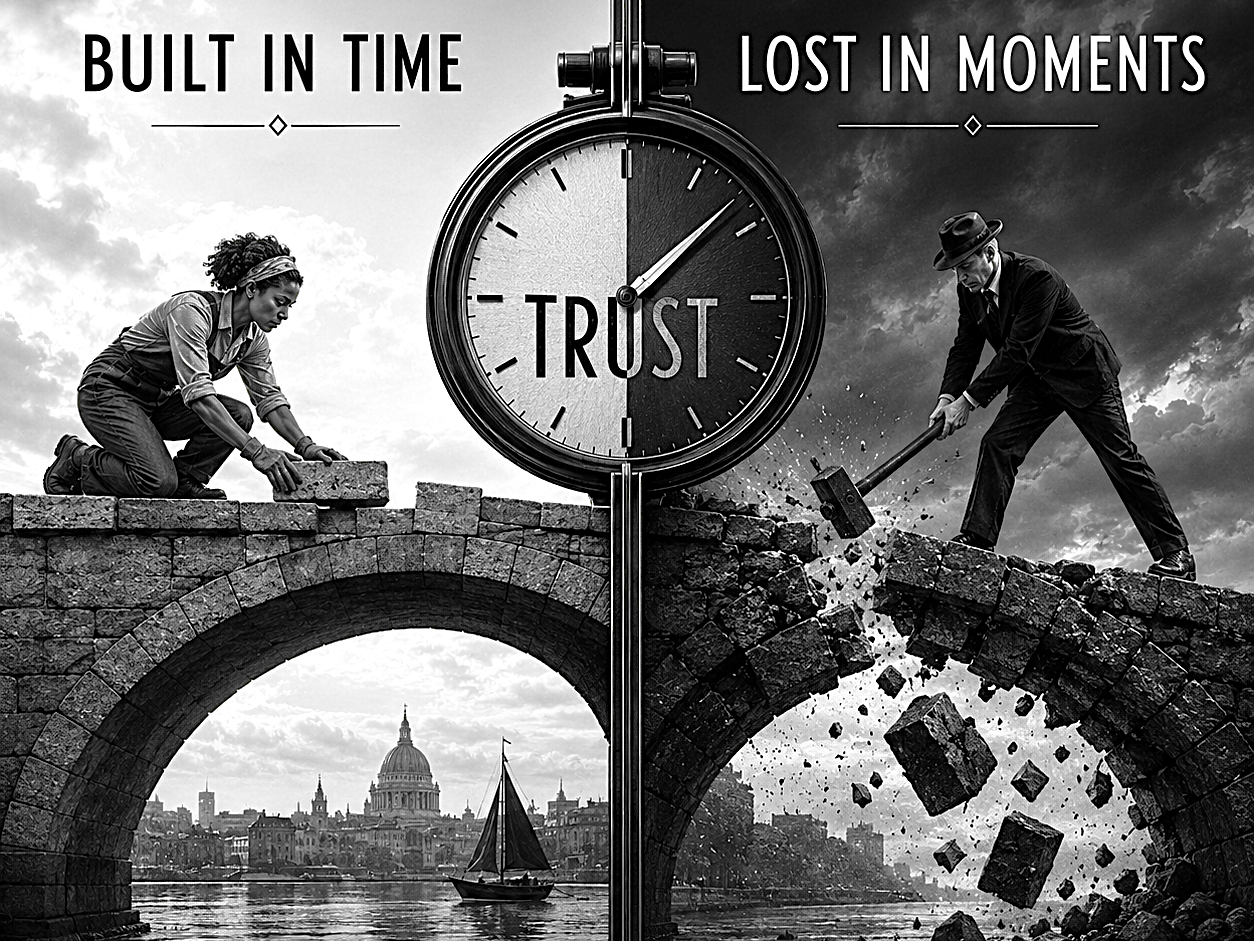
Trust is a slow accumulation and a fast collapse.
| THE LEADERSHIP QUESTION Your marketing team has spent years building customer trust. Has your testing strategy been funded as if it were responsible for protecting that asset? |
Cyber security and quality engineering aren’t competing line items. They’re complementary disciplines protecting the same asset. Cyber teams detect, contain, and respond. Quality engineering determines whether your systems behave well under the conditions cyber events – and quality failures – create: whether they degrade gracefully or catastrophically, recover in minutes or weeks, contain damage or compound it. The organisations that emerged from the 2025 retail attacks with reputations broadly intact had invested in both, not because they predicted the specific attack, but because they had treated resilience as something to verify, not something to assume.
Your customers won’t care why your platform broke. They will only remember that it did. Remember trust is built in all the releases that didn’t fail. It’s then gone in news cycles that didn’t have to happen. And the brand work your colleagues spent years building will not magically reappear because the post-incident review concluded the cause was technically a security event rather than a quality one.
Trust accumulates slowly and collapses rapidly. Treat your testing strategy as one of the things standing between those two states. It costs less than you think – and it protects more than you’ve realised.